


News
Italian Air Force: I love this kind of life, but it can be very demanding // Humans of NATO Days
Captain Jacopo Fainozzi Perini, callsign Conte, offers a glimpse into the world of military aviation that visitors rarely get to see. In this interview, he talks about his journey from a small flying club in Bergamo to the cockpit of the C-130, his training in the United States, and missions ranging from para-operations to the evacuation of Kabul and supplying Antarctica. He also reveals the less visible side of his job – the role of a commander who must keep his crew grounded and focused during long deployments. The result is an honest and compelling look into the life of a pilot for whom flying is both a duty and a joy.
Can you introduce yourself? Who are you and what do you do?
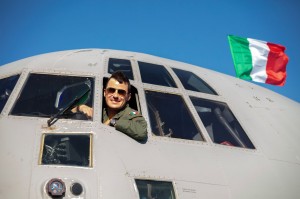
Yeah, of course. My name is Captain Jacopo, callsign Conte. I'm the commander today, on the apron here in Ostrava. First of all, thank you so much for having invited us. I love the Czech Republic. It's a country where, when I can, I come every time I'm on holiday. I love it. So, děkuji.
About myself: I joined the Air Force Academy 15 years ago, in 2010. My path was kind of standard for a military pilot in Italy. I spent five years of my life in Naples attending the Air Force Academy. There you have to do a lot of subjects, even not related to flying itself, but also about leadership. That's because our job is not just being a pilot, but we are also officers and leaders.
Today my primary duty is flying. In a few years, it will be commanding other people. After the academy, in 2015, I spent a year in Texas, where I got the first level of military pilot's license on the Texan T-6 II. After a year there, I returned to Italy and completed my military pilot's license on the Piaggio P180, a business/medical aircraft. I learned what it means to fly as a crew, not as a single pilot.
Then after that, in 2017, I was assigned to the 46th Air Brigade in Pisa, where I attended training on the C-130. It takes about a year and a half to get the full combat-ready qualification because this is a complicated airplane.
Then in 2021, I was deployed to Afghanistan, and I was there as operational officer during the evacuation of Kabul. It was a very interesting experience. A year later, I started my aircraft commander course, and I have been the aircraft commander for three years. And I'm proud to be here commanding the C-130 here in Ostrava.
Was it your childhood dream to become a pilot?
Oh yes, of course. First of all, I grew up eating pasta and watching airplane landings. My hometown is Bergamo. You know, my dad is a leisure pilot, so every Sunday I was in the club watching plane landings. And then I was born in 1989. In 1986, the Top Gun movie was released—so my childhood was Sunday at the club, and then at least two, four times per week I needed to watch Top Gun. So I grew up with this dream and goal to be a pilot. Military pilot, to be exact.
What aspects of Italian military aviation will most surprise or interest the visitors of NATO Days?
Yeah. First of all, Italy is the special partner of the NATO Days this year. And I'm sure that our visitors can appreciate the diversity and variety of the planes we brought to Ostrava: from the cargo plane like the C-130, through the Navy guys with Harrier, to the F-35, the last-generation fighter. And there are also my colleagues doing the display of the M-346, the trainer I consider the most advanced in the world.
And also the “little bird,” the C-27J, which is a tactical cargo that is displaying aerobatics and stuff that normally a cargo plane is not able to do. But thanks to my colleagues, they do even aerobatics in a cargo plane.
Italy can offer to NATO a wide range of capabilities: air transport, training, electronic warfare, and disarmament.
We don’t have the aircraft on display here, but we also have airborne early-warning radar capabilities with the Gulfstream G550. So, Italy is not a very big country, but our Air Force can offer a wide range covering all the needs of modern military aviation. Basically, the size and scope of what we can do in a small scale—everything.
Talking about the C-27J Spartan - can you explain how can such a large aircraft be so agile?
The C-27 is on display, I fly the C-130. The C-27 is a different aircraft—two engines vs. four engines. They look similar, but the C-27 is a 100% an Italian project. Its design is made for very tactical flights. It is very agile. Test pilots were able to fly aerobatics on that—of course the airplane is without cargo and so on. But it’s very demanding for a cargo plane to do that. That’s because of the special design and the ability of my colleagues.
Would you try any of those acrobatic things with this plane?
Oh, I would love to. You know, I’m a C-130 pilot, and my job is to fly everywhere in the world, to deploy everything everywhere, in every condition. But I like every airplane. It’s more than welcome for me—even on a Cessna is fine.
Could you describe what a typical workday looks like for you?
Oh, it's a good question, because I don’t have an answer. Honestly, I don’t have a typical day. It depends—we cover a wide range of activities. Easily on Monday I can fly somewhere deploying personnel. The day after I can fly over Pisa for some para-activity. On Wednesday maybe I'm involved in air-to-air activity.
Then, as senior captain and officer, I have to take care of the squadron I’m in charge of. So sometimes I have to care about personnel because I command them. I love this kind of life, but it can be very demanding because you don't know what to expect the day after.
What is the biggest challenge of flying such a large aircraft?
When I was co-pilot, my primary duties were related to flying the plane itself—planning, making sure the aircraft commander is aware of everything he or she needs. That’s the job of a co-pilot.
As an aircraft commander, my primary task is not flying—it's given for granted that I can safely fly the airplane. My job now is to be the leader of the team. On the C-130, we usually have two pilots and two loadmasters. I am the leader, the decision maker. Sometimes it’s challenging, especially when you stay away for a month in not very nice parts of the world. You have to maintain a friendly environment, make sure people are not stressed out, that everyone is confident, that they don’t have problems at home so they can focus on the job. Sometimes working with people is much more complex than working with aircraft.
But as a commander, it’s really cool, because when a mission is completed without problems, or when the crew says at the end, “Thank you, very good leader,” it’s satisfaction.
Is there an unforgettable experience you would like to share?
Yes, two experiences. The last one, very pleasant, was last year when I flew down to Antarctica with the C-130. It was one month in New Zealand, and from there we flew to Antarctica to supply the Italian base there. We landed on the ice on the sea. It’s a fantastic experience because not many people have been to Antarctica and landed there on ice.
Flying there is incredible—another world, a big white desert, no air traffic, nobody comes to see you. It’s something you can understand only by doing it. That for sure was the most amazing experience in my life. I have to say thank you to the Air Force and to Italy for letting me do that.
The other one was the evacuation of Kabul in 2021. I was in charge of the C-130 operations. In 15 days we evacuated over 3000 people—Italian personnel and many Afghan personnel that collaborated with us. I was surprised by the results, because other nations had C-17s, but we had five C-130s and were able to evacuate over 3000 people. All went smooth, no safety issues. It was very hard and demanding—missions lasted from 24 to 30 hours. From 15th to 29th of August, there wasn’t a single minute without an Italian airplane flying over Afghanistan.
In the end, we saved so many lives, and I’m very proud of that. And a year later, an Afghan soldier who was evacuated attended the Air Force Academy with me. He wrote me a message: “Now I'm in Italy, I'm safe thanks to your job and your team.” It was very moving.
|
|

Thanks for your service. Now let's get back to the Czech Republic.
Have you interacted with visitors here at NATO Days? Any moments that stood out?
Oh yeah. I'm sorry for those who couldn’t visit the airplane, but yesterday we had 95,000 visitors. It’s a huge number, and I cannot let everyone inside the plane. But I was very happy because many people approached us asking questions, taking pictures. Many children are interested in aviation and what we do—they understand it's not about making movies, but also about serving, not only my country but our Western partnership. I was proud about that.
Yesterday, even before the we opened the plane, we were already assaulted by people wanting a picture with us. It's very pleasant because I am a completely normal guy, 35 years old, a man with dreams and problems. I’m an ordinary person. For a moment, we feel like superheroes—but we are completely normal people.
If you could send a message to the visitors, what would it be?
Enjoy your stay. Have questions, because we are here for you. I’m pretty sure that out there are many children whose dream is to be a pilot or to be military. Follow your dream, do whatever you feel is good to do, and if you give effort, you will get the results.
Anything you would like to add?
Thank you to the Czech Republic. You have a beautiful country, and I hope to return as soon as possible. And if you want the C-130 for next year in Ostrava, I volunteer.
Thank you very much indeed. It was a pleasure.
Děkuji!
Partners














.jpg)