


News
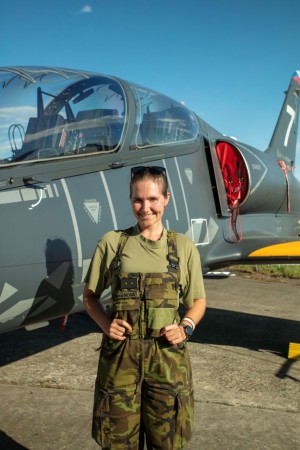
2LT Barbora Nová, Czech Air Force: From the aeroclub to the Airbus // Humans of NATO Days
During secondary school, Barbora Nová’s interest in the military and aviation led her all the way to overseeing the maintenance of L-410 and Airbus A319 aircraft in the rank of Second Lieutenant. In the interview, she describes a typical day on base as well as during events such as NATO Days in Ostrava & Czech Air Force Days, what she enjoys most about being a technician, and what it is like to be a woman in the male-dominated environment of military aviation. She also shares inspiration for young people considering a career in the armed forces.
What led you to a career as an aircraft technician? Did little Barbora dream of being in the armed forces and looking after aircraft?
It would never have occurred to me before, but during secondary school I became interested both in the military and in aircraft as such. I started flying at an aeroclub and immediately knew it was the right field for me. University followed – the University of Defence in Brno, Faculty of Military Technology, specialising in Aircraft Technology – airframes and engines – and then joining a unit, my first type rating (on the L-410 Turbolet), some practical experience, a second type rating (on the Airbus A319), and that brings us to the present, after almost three years on base.
Which aircraft do you enjoy working on the most?
That’s a difficult question. I’ve only worked on two types so far, but I have a positive relationship with both. The L-410 is considerably smaller than the Airbus, so it’s a bit more accessible. On the other hand, the Airbus has more systems with more components; you more often deal with replacing units and can really get stuck into it.
You serve at the 24th Air Transportation Base. Is there an aircraft you don’t have at the base but would like to work on as a technician?
For now, I don’t have such ambitions. I’m still gaining more and more experience with my current types, and there is always something new to learn.
Have you taken part in any overseas deployment? If so, can you tell us more about it?
I haven’t been on an overseas deployment yet; I haven’t been at the base very long. And apart from the MFO mission in Sinai with CASA aircraft, technicians don’t usually deploy very often.
On the other hand, we can fly with the Airbus as accompanying technical personnel, which gives us a great opportunity to see different parts of the world. Unfortunately, this doesn’t apply to me yet – I still need to improve my qualifications and, above all, gain more experience. But it’s a goal I’m working towards and something I’m really looking forward to. It will also mean that I truly know the aircraft and have the necessary skills.
When people think of the air force, they usually picture men in most roles. How do people generally react when you tell them what you do?
Most people raise their eyebrows in surprise and stare for a moment in disbelief. But then enthusiasm, interest, and questions usually follow – especially about how I got into it in the first place. It always makes me reflect on that myself. I was probably influenced from an early age without realising it, as my grandfather used to repair mostly cars and could take anything apart down to the last screw, fix it, and put it back together again. That stayed with me – the idea that I wanted to be able to do the same. And since I loved maths and physics at secondary school, I wanted to pursue a technical field, knowing pragmatically that even if I didn’t join the military, technical professions are always in demand.
That said, I don’t want to discourage those who aren’t fond of maths — there are plenty of them at the airfield as well.
As part of the military modernisation, there are plans to acquire the C-390 aircraft. How are you preparing for it?
Personally, I’m not preparing for it in any particular way. The aircraft will be based with a different squadron, and my primary types remain the Airbus A319 and the L-410 Turbolet.
Two female generals have already served within the Czech Ministry of Defence. Do you still encounter any glass ceilings? Or do women now have the same treatment and opportunities as men?
I would say that women have the same opportunities. If they want to do a particular job, I don’t see any reason why it shouldn’t be possible – perhaps with the exception of certain combat units and the like, but I don’t know much about those. As for treatment, I think it depends on the specific team. In some places, they may already be used to women, while elsewhere they are still something of a rarity. Personally, I certainly can’t complain. At airbases in general, the teams strike me as very good, so fitting in usually isn’t a problem. After that, it comes down to the individual – whether they want to do their job well, learn what’s required, and simply be a fully-fledged member of the team.
Have you ever wanted to try flying the aircraft you maintain, or do you prefer keeping your feet on the ground?
As I mentioned, I started out in the air. Not with transport aircraft, of course, but I have a very good idea of what it’s like to pilot aircraft and to be up there. It also helped me at the beginning to understand the connections, and maintenance and repairs were not as unfamiliar to me as they might otherwise have been. However, since I already had a pilot licence and was more interested in the technical side, I chose to continue into the military, where you can work with interesting pieces of engineering.
What does your typical working day look like – both on base and during events such as NATO Days in Ostrava & Czech Air Force Days?
A typical working day is quite hard to describe, because no two days are the same. It can be calm: I arrive at work at 7 a.m., we start with briefings where we plan the work, decide who goes where, deal with necessary matters, and then we go on to tasks such as replacing a block or a valve on the Airbus. Sometimes it involves small jobs that we can complete in the morning, while other times it can be something like an A-check (maintenance carried out every three months), which can take several days.
At other times, you prepare aircraft for departure, or catch them when they arrive and carry out a so-called post-flight inspection, which is a matter of hours. That’s where it can get interesting, because especially during post-flight checks, a fault may appear that needs to be dealt with, or the aircraft may arrive or depart very early in the morning or very late in the evening – at least when it comes to the Airbus.
It’s simply a very varied job, and I like that I’m not sitting at a desk in an office all day. Although, of course, you also spend a lot of time on documentation, which is an inseparable part of technical work. Especially for officers, this paperwork (or rather computer work) sometimes even dominates, and it is not unusual for it to take up an entire day.
|
|

On the other hand, during events such as NATO Days, my day looks completely different. Specifically in 2025, I wasn’t doing my usual job at NATO Days, meaning I wasn’t taking care of aircraft. Instead, I helped at the 24th Air Transportation Base stand, where we informed visitors about our base and our work, or recorded short videos – again to let visitors know what they could expect and what they could look forward to.
What do you enjoy most about this job?
The equipment. The technical side still fascinates me a great deal and I really enjoy it. I also like the variety – no two days are the same. And let’s be honest, I work with a great team, and that makes a huge difference; it makes you actually want to come to work.
What would you say to young people, and specifically to women, who are considering a career in the air force or the military?
It’s great in the air force. Whether you want the opportunity to see the world or to get deeply involved in aircraft, the air force won’t disappoint you. There are many different roles that can suit just you. And if you don’t happen to want to join the “blues” (the air force), I believe the military offers many other interesting professions as well.
Partners