


News
Capt Jan Ratz, Czech Air Force: So people feel trust and respect for our work // Humans of NATO Days
From gliders to the Gripen. Capt Jan Ratz, also known as “Gust”, is the sixth Czech display pilot of the JAS-39 Gripen. In the interview he tells us how his childhood dream of becoming a pilot turned into reality, how he got his callsign, what he experienced during his very first solo flight, and he also has a message for those who dream of a career as a military pilot.
What was your path to the Gripen cockpit like? Was becoming a military pilot your childhood dream?
Yes, it was my dream. Although at the beginning not exclusively to be a military pilot, but rather a pilot in general. Already at primary school I was finding out how to achieve this dream. That led me, at the age of sixteen, to the Staňkov Aeroclub in western Bohemia, where I completed glider training, which absolutely captivated me. At the same time, I started studying at a secondary technical school of transport with an aviation focus in Masná Street in Prague.
Later on, I continued my training on powered aircraft, this time at the Plasy Aeroclub. However, a crucial period for me was when I was thinking about university. That was when I found out that the University of Defence in Brno existed, which offered – and still offers – a military pilot programme. That was a clear choice for me. I was successfully accepted to the University of Defence, and after basic and selection training on Zlín Z-142 training aircraft, I was selected for tactical aviation, partly thanks to my previous experience from aeroclub flying.
There I then gradually completed training on the L-39C and L-39ZA, the L-159, and in 2020 I completed conversion training on the Gripen in Sweden.
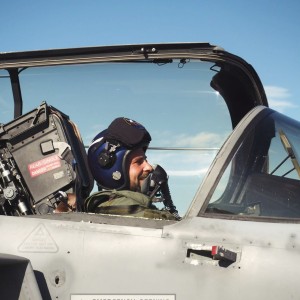
Do you remember the moment when you first sat in an aircraft cockpit?
Oh, absolutely! That’s a memory that is indelibly etched into every pilot’s mind. It was a wonderful feeling, especially at the moment when, shortly after the tow rope was released in the glider, I turned around to check that I really was sitting in the cockpit alone. On the one hand, it filled me with a feeling of a certain uniqueness, because flying an aircraft solo before you are even allowed to sit behind the steering wheel of a car is simply something you wouldn’t normally expect. On the other hand, there was also a great sense of responsibility, when I realised that there really was no one else there who could get the aircraft safely back on the ground.
I would say that at that moment it was a big step towards adulthood in a teenager’s life. And it’s truly great that our legislation allows this, and I would warmly recommend it to anyone who is even slightly considering it.
Your aviation journey began with gliders, in which you also achieved significant success. What do you enjoy most about gliding?
Thank you. I enjoyed gliding from the very beginning, but it turned into a real passion the moment I first tried competition flying. There, besides the flying itself, I also enjoy the great group of equally “crazy” people of all ages from all corners of the country who share this passion, and with whom I have experienced many wonderful moments, not only in the air.
As for glider flying itself, I never cease to be fascinated by how much can be achieved with such a “simple” aircraft using only nature. If I want to cover a longer distance in a glider, unlike in a powered aircraft, I have to earn it. I have to try, I have to think about it, and I have to plan the flight well. And if everything works out, nature cooperates and you manage to fly a really nice performance, it’s a priceless feeling. Simply put, covering distances in gliding is always a kind of challenge that I miss in powered aircraft.
And what, on the other hand, draws you to the Gripen, which is essentially the exact opposite of gliders?
Flying the Gripen is a completely different world. The Gripen is a very powerful aircraft, and it allows you to fly things that no other aircraft in the Czech Republic can do. And it’s definitely not just about aerobatics. It’s mainly about teamwork, tactics, leadership and communication skills. It’s also about cooperation and sharing experience with our foreign NATO colleagues. It’s also about constant education and developing ways to use the aircraft to its maximum in our favour and for the tasks that are – or could be – assigned to us.
In short, it’s also a challenge, but in a slightly different sense of the word. Above all, it’s a job that makes sense and fulfils me. In this work I often think of the legacy of Czechoslovak pilots in the RAF, who did incredible things for our nation, and I am convinced that I, and all my colleagues, would be willing without hesitation to follow in their footsteps if it were – God forbid – necessary.
Can you tell us how your callsign “Gust” came about? Is it a reference to gliders?
Among military pilots, it is a tradition that they are given nicknames or callsigns, which very often arise from something the person did or didn’t quite manage – especially if it has a humorous context.
In my case, for example, I once unintentionally landed a Gripen. It happened during our deployment on a mission in Lithuania. When returning from a flight, the airfield conditions were such that wind gusts exceeded our training limits. I decided to perform only a low pass over the runway to try out – purely out of curiosity – how strong the low-level turbulence caused by the wind was.
However, I misjudged my height above the runway and unintentionally touched down with the landing gear. After that, it seemed silly to add power again, go back into the air and wait for the wind to calm down, so I completed the landing. Nothing bad happened, except that my colleague then waited for about fifteen minutes until the rain shower that was causing the strong gusty crosswind moved far enough away for the wind to drop below the prescribed limit.
At least from the air traffic controllers’ point of view, it must have looked rather strange. And since then, I’ve been Gust.
Do you remember when you found out that you would become the JAS-39 Gripen display pilot? Is a pilot nominated for this role, or do they apply for it?
In our squadron, there is an unwritten rule of roughly three years in the display pilot position, and it was clear that my predecessor, Capt. Ondřej Španko, would be handing over the baton. The decision as to who would succeed him was then in the hands of our squadron command, which of course knows the experience, abilities and preferences of the pilots of the 211th Tactical Squadron.
As far as I know, none of my colleagues applied actively in advance, because it was clear that we were all interested. Rather, we waited in anticipation to see who would be selected. I found out that it would be me roughly a year in advance.
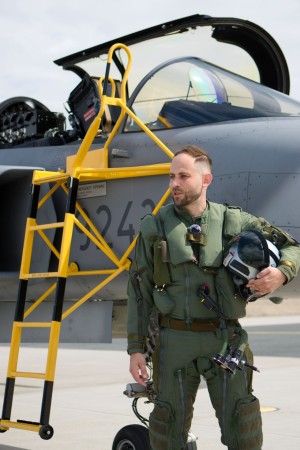
You are the sixth Gripen display pilot in the Czech Air Force. How do you follow on from your predecessors?
I have great respect for all the guys who flew before me. For me, they are heroes who have become living legends of Czech military aviation. For example, I had the chance to see the first Czech Gripen display pilot, Tomáš Merta, flying at airshows even before I myself became a soldier. And I think that, without even realising it, he also played a part in me becoming a military pilot.
It is precisely this inspiration of younger generations towards a career in aviation that we all follow on from each other in. We want to show young boys and girls that aviation is great and that it’s worth dedicating themselves to it. And that is a legacy I definitely want to continue as well.
What was your first season as a display pilot like? Is there a moment you remember most fondly?
During my first season I flew several wonderful events – starting with the Open Day at Čáslav Air Base, through Aviatická pouť and the French Somme, all the way to NATO Days in Ostrava. However, the moment I remember most fondly was at the international airshow in Sanicole, Belgium.
I was part of the evening show there. The weather was relatively complicated, but I was lucky and at the exact moment of my display, an orange-coloured sun appeared between the clouds, just above the horizon. It created a beautiful golden atmosphere against the dark background of black clouds. Not only was it magical to be in the air at that moment, but many beautiful photographs were taken, so I believe the spectators were thrilled as well.
You have also been deployed in Lithuania for Allied air policing. What does flying in such an environment have in common with displaying an aircraft’s capabilities at public events?
At first glance, it may seem like two completely different tasks, but in reality there are common features. In both cases, it is crucial to have the aircraft firmly under control while strictly adhering to procedures in order to ensure the highest possible level of safety. Both tasks require a high degree of concentration.
I would say, however, that during air policing the pilot – and not only the pilot – is under greater pressure, especially time pressure, and must be able to react correctly in unexpected situations. Weather is also a limiting factor that must be taken into account both during an airshow display and during air policing.
In both cases, however, it would not be possible without a team of people working around the aircraft, helping to prepare it for flight, nor without air traffic controllers. In fact, it is surprising how many people are involved in operating an aircraft, whether directly or indirectly. The main common feature is therefore the team of skilled people who always stand behind it all.
At NATO Days, the display line is somewhat unusually perpendicular to the runway. How does preparation for the show in Mošnov differ for you compared to other events?
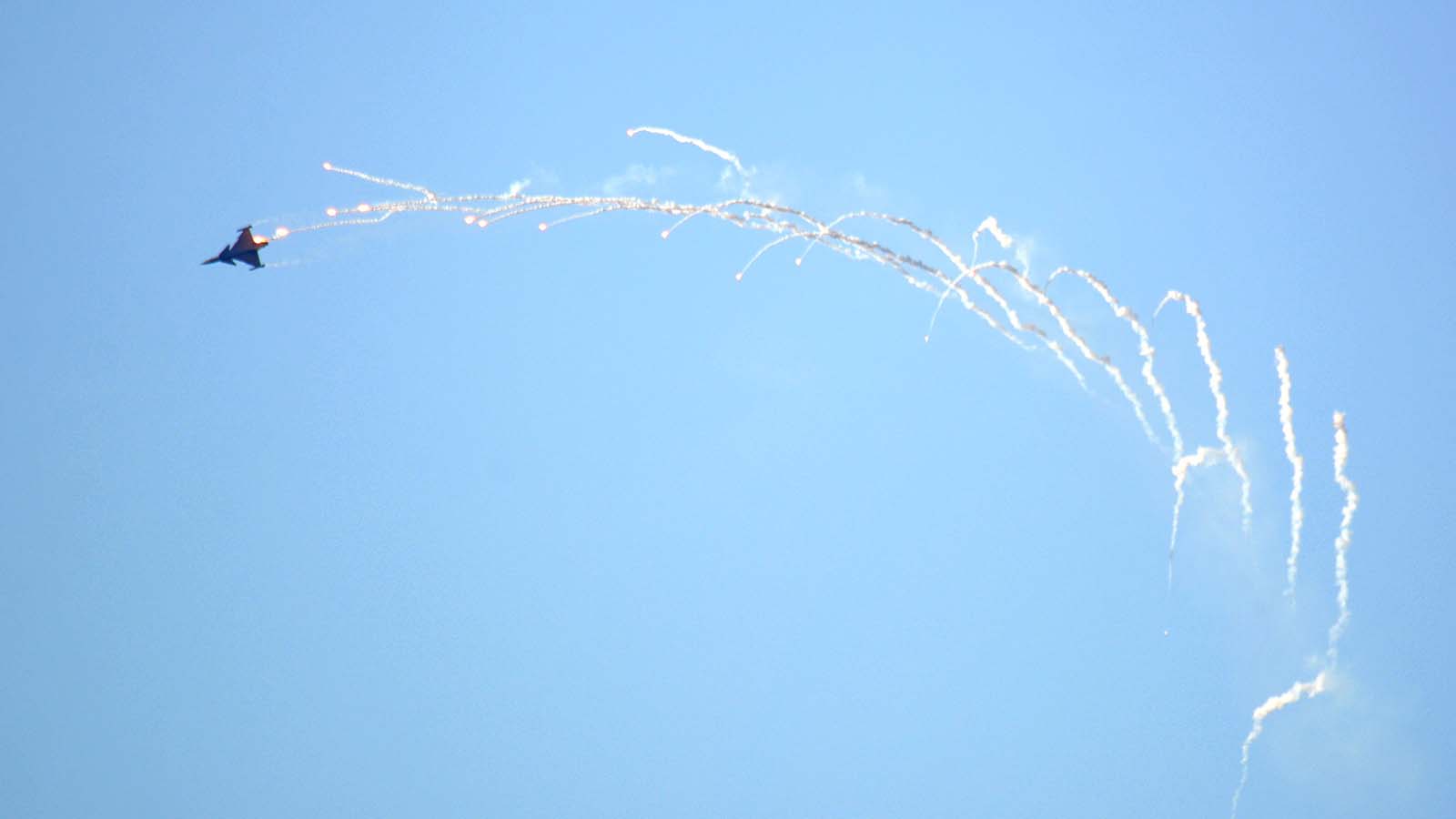
I would say that almost every airshow has its specifics, but the display at NATO Days really does stand out a bit. The placement of the display line perpendicular to the runway is just one of the things that forced me to adapt the routine. In Mošnov, for example, there is also quite limited space for releasing countermeasures, which required further minor adjustments.
In such cases, I make extensive use of the Gripen simulator, which has very faithful flight characteristics of the real aircraft. There, I can try out and practise all the necessary adaptations in advance, so that I am confident I can fly everything with the maximum level of safety. An important part of the preparation is also practice directly on site before the event.
What does your typical working day look like – if something like that even exists for a military pilot? And what does your day look like at an event?
A standard flying day always begins with a briefing, where we receive all the necessary information – especially about the weather, the status of the home and alternate airfields, radio navigation aids, airspace, any restrictions, or planned traffic. In short, everything that could affect us.
After that, the flying plan for the day is created, and that is the moment when pilots find out what tasks they will be carrying out and can then start preparing for them. During preparation, for example, coordination with military controllers is required, a group briefing is conducted, and the flight plan is prepared and filed. At this stage, it is also necessary to agree on what will happen in the event of an emergency.
Then comes the flight itself, which usually lasts around one hour. After returning, the cycle starts again, because the flight needs to be evaluated – analysing what went well and what didn’t, so that the team can learn from it. There can be several such flights in one day. If we are not flying, we have access to the simulator, which is ideal especially for training emergency situations. Physical preparation and studying procedures and regulations are also important. From time to time, survival courses or parachute training for emergency ejection are organised – in short, we really don’t get bored.
|
|
A day at an event is essentially similar. The flight director also organises a briefing. Pre-flight preparation in terms of coordination and briefings is simpler at an event, because I fly as an individual. Even so, I still have to actively communicate with technicians and organisers, especially regarding display times or unexpected events that may disrupt the airshow programme. The display flight itself then lasts a maximum of ten minutes. During the airshow there is also an accompanying programme, where it is possible to meet spectators directly. In addition, part of a display pilot’s job is cooperation with the media. That is a significant difference compared to a normal day of a military pilot.
Is there a manoeuvre in the display programme that you feel best shows the character of the Gripen? Or your favourite one? Or perhaps a manoeuvre flown by someone else that you would like to incorporate into your display in the future?
I think that the character of the Gripen cannot be fully expressed by a single manoeuvre, but every display pilot tries to show the character of their aircraft through the whole routine. The Gripen, for example, is very willing to roll around its longitudinal axis using ailerons, and I think I have many elements in my routine that make use of this characteristic. These include, for instance, timed rolls – both fast and slow.
I also try to show the wide speed range of the Gripen – from a minimum speed of around 180 km/h up to a maximum subsonic speed of approximately 1,100 km/h. I show manoeuvres with maximum load factors, both negative – for example in an inverted turn with up to -3G – and maximum positive load factors of up to +9G, which I reach at several points during the routine.
There are several manoeuvres that I like. In fact, when I think about it, there isn’t really one that I don’t like. In my routine, for example, I have a roll with the landing gear extended at the start, and I also really enjoy performing a landing from a reversal. Unfortunately, both of these manoeuvres are somewhat lost in Mošnov due to the orientation of the display line.
Personally, I really like the display of my French colleague on the Rafale, which I had the opportunity to watch at several joint events during the past season, including at NATO Days. And although it can be a bit tricky to take inspiration from aircraft with significantly higher performance, such as the Rafale, I would like to incorporate some elements of his manoeuvres into my routine.
What would you like people to take away from your display, even if they know nothing about aviation?
I would like people to take away a feeling of trust and respect for our work. They don’t have to know the details or understand individual manoeuvres – what’s important is that they perceive us as professionals who place emphasis on discipline and safety, which we put into every flight. And if the display additionally sparks an interest in aviation, equipment, or a relationship with the armed forces as part of our sovereignty and security, then it has fulfilled its purpose.
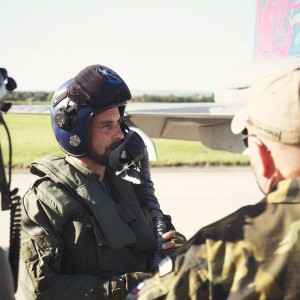
And one slightly more personal question – is there something about you as a military pilot that would surprise people? Your predecessor Ondřej Španko is known for his artwork, and a Canadian Hornet pilot told us he is afraid of heights.
Well, I’m not particularly afraid of heights. On the contrary, I’m drawn to various adrenaline sports and I’ve tried quite a lot – from bungee jumping and surfing to windsurfing. In addition to the mandatory jumps in the army, I have also completed several civilian jumps with a ram-air parachute, and slacklining or rock climbing are not unfamiliar to me either.
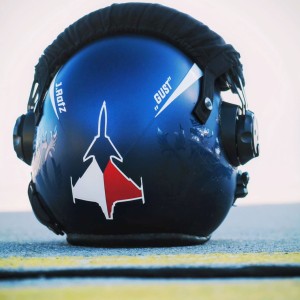
I also enjoy creative work. Although it’s hard to match Ondřej, I have designed several T-shirts and other souvenir items, mostly with an aviation theme. I also designed the helmet I fly with myself. Aircraft 9234, which received a new livery to mark 20 years of Gripen operation in the Czech Armed Forces, was created based on a joint design by Ondřej Španko and me, although I would consider him to be the main author.
What would you say to someone who dreams of becoming a military pilot one day?
Definitely don’t give up too early. In my life I have met many people who told me that they once had the same dream, but gave it up perhaps just because they heard about some minor medical limitation that would disqualify them. But if you truly dream of it and want to do this job, don’t let yourself be easily discouraged and go for it with everything you’ve got.
Partners














.jpg)