


News
Karel Mellar, Municipal Police Ostrava: I owe many things in my life to dogs // Humans of NATO Days
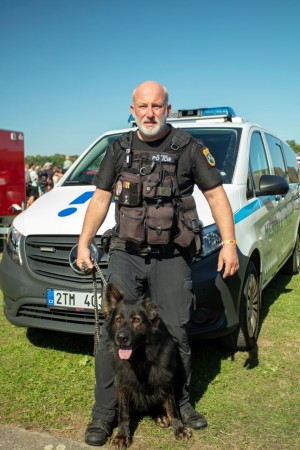
Karel Mellar has been serving with the Municipal Police in Ostrava for nearly 25 years and has been involved in canine work since childhood. He specialises in protection training and decoy work, and over the course of his career he has handled and trained a number of service dogs. He is currently on duty with a German Shepherd named Eliot Ma-La-No Opava. In the interview, he describes what the work of a municipal police dog handler looks like, what training involves, as well as the day-to-day life with a service dog and how a strong bond develops between a handler and his four-legged partner. He also shares his experience from public displays, including the NATO Days in Ostrava & Czech Air Force Days, and highlights how to behave properly around service dogs.
Could you introduce yourself and your current four-legged partner to us?
My name is Karel Mellar, I am 51 years old, and I have been involved in canine work since I was nine. From the very beginning, I have worked with German Shepherds, and I have remained loyal to the breed to this day. Although I enjoy all disciplines of dog sport, my main activity – or rather my life’s calling – is protection work and decoy training.
My current partner is a six-year-old long-haired breeding German Shepherd, Eliot Ma-La-No Opava, who is the grandson of my previous service dog, Yetti ze Stříbrného kamene (Yetti from Silver Stone, ed. note).
You have been working for the Municipal Police for 25 years. What led you to canine work and to joining the Municipal Police in Ostrava? Was it your childhood dream?
Yes, I have been with the Municipal Police for nearly 25 years. As I had been involved in canine work since childhood, I simply continued to develop this passion in adulthood. Gradually, I began preparing service dogs for the army, helping friends in the police, working as a decoy, and training with the prison service. Then came an offer from the Municipal Police in Ostrava, where dogs from our breeding lines were already in service at the time – and I have stayed there ever since.
What do you enjoy most about canine work even after all these years?
For me, it is more of a way of life. So probably canine work itself and everything that comes with it.
Over the years of your service, you have worked with several dogs. When your canine partner retires, do you keep them with you? Do you also have any dogs you have not worked with professionally?
The Municipal Police in Ostrava operates a system in which the dog is owned by the handler. This suits me perfectly, and the dog is constantly with me – travelling to and from work with me and being a member of the family throughout its life. After retirement, the dog then remains with me.
I have always had several dogs. Right now, in addition to Eliot, who is currently in service, I also have his predecessor, thirteen-year-old Amir Jesenius, and the youngest, Groot Ma-La-No Opava, with whom my son actively trains and competes.
What does a typical day look like for a Municipal Police dog handler? How much time do you spend training your dog, and what does it involve?
There is probably no such thing as a typical day. However, it always begins with preparing the dog and taking it out. Since the dogs are with us throughout the entire shift, they need to be regularly let out of the car to stretch and run around. Training with colleagues is also part of the job – for example, searching buildings, working in open terrain, or protection work. Of course, training does not only take place during working hours. As we keep the dogs at home, I also include tracking and obedience outside of duty, for instance when I am training with my son or with friends. And how much time does it take? A lot – but I prefer not to keep track of it anymore.
In your opinion, what is the most important factor for successful cooperation between a handler and their four-legged partner?
They definitely need to “click”. It does not always happen, but if the two-legged member of the team is lucky with their dog and brings empathy, a bit of common sense, expertise, and also understanding when the dog does not immediately grasp what is required, they can form a successful team together.
They say that every German Shepherd owner secretly wishes their dog would bite someone at least once. Did that ever happen during your service, or do the dogs have a strong enough deterrent effect?
I have to admit, I’m not sure about that “wish”. Perhaps it’s connected to every handler’s interest in whether the training and preparation were effective and produced results. In sport, we can test that at competitions, but the question of whether a dog trained to bite protective equipment, such as a ring suit, sleeves, or cuffs, will perform in a real-life intervention without those aids crosses every handler’s mind at some point.
I believe, however, that most service dogs have no problem with this at all. Fortunately, service dogs also continue to serve as a highly effective deterrent.
At public events, visitors can often see you in the role of a decoy. However, that requires specific certification. Could you explain this role to us?
In the past, it was enough not to be afraid. However, it is certainly beneficial to train occasionally with someone who behaves naturally, without the habits and movements of an experienced decoy.
In sport canine disciplines, a decoy must be certified in order to take part in events – not only so that a judge can objectively assess the dog, but also to minimise the risk of injury to both the dog and the decoy. We want dogs to be fast, strong, and uncompromising, yet still controllable. This places high demands primarily on decoys – their expertise, experience, and physical fitness.
The same applies to service dog work. Although certification is usually not required, many service decoys come from a sporting background. Even in training a service dog, it is essential to follow proper methodology – the decoy must know exactly what to do at each stage and how to react to different situations. It is important to realise that any mistakes will not show up in competition, but may only become apparent during real deployment.
Even at public events, it is not just about the bite itself. It is necessary to constantly monitor whether the entire situation is unfolding correctly and whether the dog has assessed it properly. For example, I once had to react quickly when a child ran into the display area at the exact moment the dog was charging in to intervene.
What has working as a dog handler taught you about people?
Working as a dog handler is like any other profession – your experiences with people depend on the kind of individuals you encounter. I believe that the negative experiences have not left any lasting impact on me.
We have an idea of what you have taught your dogs, but what have they taught you in return?
When I recently reflected on my past, I had to admit that I owe many things in my life to living and working with dogs. Especially in the early days – as I mentioned, I got my first dog at the age of nine.
It taught me responsibility, for example – a dog needs to be properly cared for. When things do not go well, you must not give up, but instead look for ways to solve the problem. In training, it has also taught me how to explain things to a dog and motivate it to do what we expect. It has also taught me to work consistently and patiently… although I sometimes struggle with that. I am told that I occasionally explain things – even to people – in too much detail.
You are also active in canine work outside of your service. Do you still have time for interests and activities unrelated to dogs?
If I said there was plenty of time left, that would not be entirely true. But I try, and from time to time I have to carve out some time for my family and the house – and that then serves more as a form of relaxation.
What qualities must a service dog have in order to be successful? How long does it take for a dog and handler to form a strong team?
This is a very common question. A dog should certainly have a stable and balanced temperament, be quick to learn, and show no negative reactions to surfaces or sounds. However, in my view, the key factor is the willingness to work – the dog must be highly motivated and cooperative with the handler, with a natural drive to work for them. Good health and versatility are also important.
That is why all of my service dogs are also breeding dogs. To achieve the best possible partnership, I prepare my service dogs from puppyhood, so we begin building the team from the very start.
What would you like visitors to take away from your displays at events?
We usually try to show what the dogs can do, but at the same time we also want it to be entertaining. So we have had dogs jumping and biting over a car, into a car, on the roof of a car, on a table, jumping over colleagues from the public order unit, two dogs biting at once – one jumping over a car while the other came out of a moving service vehicle – performing in a simulated restaurant, and in one scene we even “set a colleague on fire”. And many other model situations. I must admit, we are slowly running out of inspiration and ideas. We often draw inspiration from real-life cases, but we always incorporate a dog into them.
However, I would also like visitors to take away some important information – for example, that a dog is not just a working tool for us. Even though it is a service dog, it must not be disturbed while working; people should not try to pet it, call out to it, or whistle at it under the assumption that it does not mind.
You have already touched on it – how should people behave around service dogs?
This is one of the things we try to explain during our presentations – that approaching a handler with a dog under the assumption that “they are not dangerous and the dog can tell” is more of a common myth. In my view, allowing a dog to be petted by strangers and then expecting it to perform flawlessly during an intervention against other strangers is counterproductive and can unnecessarily create confusion for the dog.
That is why I always politely decline, and I believe Eliot would make that clear himself as well.
So the message would be this: we are happy to talk, answer questions, or even take photos, but we prefer to handle petting and rewarding the dog ourselves. And of course, words of appreciation are always welcome, and we are grateful for them.
|
|

Could you share a funny or interesting story that happened to you during the NATO Days in Ostrava & Czech Air Force Days? Or perhaps an unforgettable experience with your service dog that you would like to share?
Presentations and display, especially at NATO Days in Ostrava & Czech Air Force Days, are more about stress and making sure everything goes according to plan.
One story comes to mind from some time ago, when we wanted to demonstrate a dog working in a muzzle. Before the scene, I was standing among the spectators in a shirt and tie, acting as a “random member of the public”, constantly provoking a police officer. The handler was then supposed to challenge me and invite me to try facing the dog. The problem, however, was that I was standing next to a very assertive spectator who decided to deal with the “troublemaker” in his own way. In the end, my colleague with the dog had to step in and rescue me – but this time from the spectators rather than from the dog.
What would you say to someone who dreams of or is considering a career as a dog handler?
Go for it – get a puppy, start training, and be prepared for the fact that you can’t “switch off” the dog. Walks have to happen even in rain or snow, the dog doesn’t get holidays, so you almost have to give up your own. And you will constantly have to explain to the people around you – who still won’t fully understand – that you wouldn’t change a thing.
Would you like to add anything in conclusion?
I would mainly like to thank you for the opportunity to bring our work and its challenges closer to people once again.
Partners